Chatbot AI will be the new advertising platform: ChatGPT, Perplexity face the opportunity to turn conversations into potential marketing revenue

With the rapid rise of chatbots, many users predict that these chatbots will integrate advertising into the service.
OpenAI is predicted to integrate advertising into ChatGPT in the future, Perplexity has long implemented advertising in chatbots
With over 250 million weekly active users on ChatGPT alone, OpenAI has a huge user base to attract advertisers.
The company has recently made a number of notable hires with experience in the advertising industry, including appointing its first chief marketing officer and inviting Shivakumar Venkataraman – Former head of Google's search advertising department became vice president at OpenAI. Ms. Sarah Friar - Chief Financial Officer of OpenAI said the company “There are no specific plans to deploy advertising”. ChatGPT, Sora, Dall-E and API services - areas that are considered to still have many revenue opportunities in the near future. Manolis Perrakis – Innovation Director at We Are Social Singapore commented that: “Introducing advertising may distract from OpenAI's core goals instead of providing long-term benefits.”
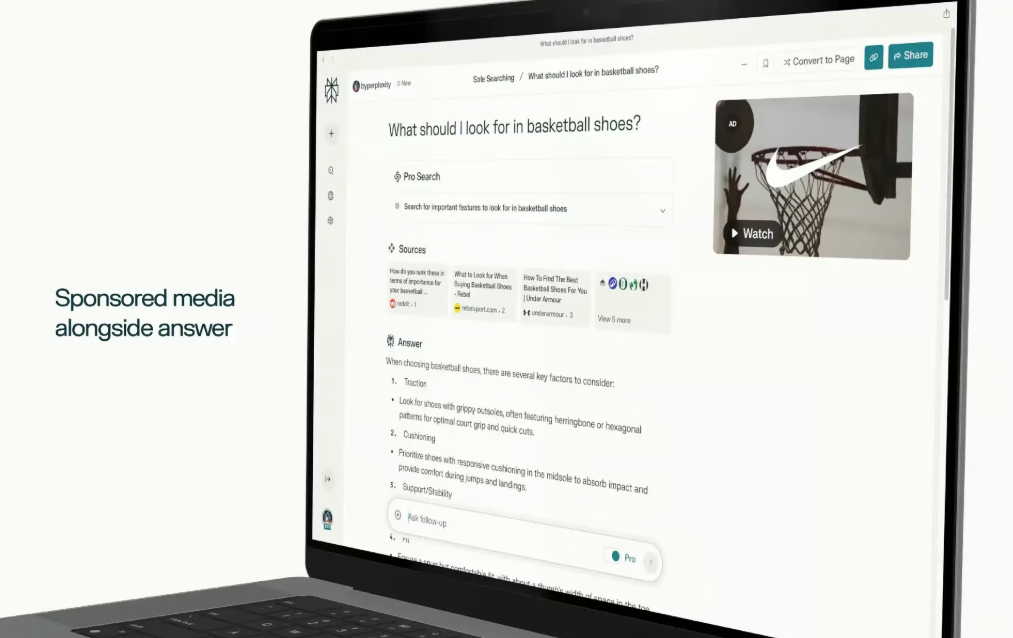
In addition, Perplexity has begun deploying many forms of AI-integrated advertising, focusing on positions in search results such as: Sponsored suggested questions, ads in the side of the screen, video ads and branded explanatory content.
Kellyn Coetzee – National Director of AI & Insights at Kinesso Australia – predicts that AI chatbots are not just a new advertising channel, but the next evolution of search: “While TikTok and Pinterest are showing off their search capabilities, ChatGPT and Perplexity are positioning themselves as the ‘Google of the future,’ thanks to their partnerships with publishers.” She added: “These platforms not only capture user attention, but also tap into user intent at the deepest level.”
Chatbot AI is not an advertising platform like other social networking sites
Unlike social networking platforms, where ads easily blend into the content stream as users passively surf, AI chatbots interact more directly and personally.
New advertising formats in the chatbot environment such as: Sponsored answers, suggested queries, interactive product demos, contextual suggestions or brand integration into feedback content,... all open up many opportunities to reach users in a more creative and personalized way.

Sebastian Diaz – Director of Media Innovation at Bench Media said: "The highly targeted ability of AI-generated content can help make ads more relevant, attracting more attention. But if ads appear too much, it can undermine trust and seamlessness in the user experience, especially for those who are using chatbots as a conversation or content creation tool."
Manolis Perrakis – Innovation Director at We Are Social Singapore same opinion: “Chatbots are completely different from social media platforms and advertising in this new environment can only be successful if the integration is smooth and does not disrupt the user experience.”
Feasibility in the chatbot advertising market is not only based on revenue potential, but also depends on the ability to delicately balance between providing useful answers and cleverly integrating product suggestions, to avoid turning the chatbot into a "digital billboard" like many websites today.

The real value of advertising through chatbots does not lie in appearing densely or attracting attention, but in making users not feel bothered.
According to Sebastian Diaz – Director of Media Innovation at Bench Media: "The difficult problem lies in creating a natural, useful and non-obtrusive advertising experience. If developers cannot control it, it will be difficult to grow immediately because the amount of advertising needs to be tightly controlled."
Another big challenge in implementing advertising on chatbots is the issue of trust from users.
The future of advertising on AI chatbots
Many experts ask: In the future, can advertising through AI chatbots become a dominant trend and "take a bite" of revenue from Facebook, Instagram or TikTok?
According to the opinion of Manolis Perrakis – Innovation Director at We Are Social Singapore, currently OpenAI's products mainly focus on search functions and productivity support, so they do not directly affect the advertising revenue of social networking platforms.
Meanwhile, major AI platforms like Meta and Google are getting ready to compete with AI platforms like OpenAI or Perplexity – not only in the advertising field but also at the technology level.
Their strength lies in their already well-established advertising ecosystem: the addition of chatbots simply expands the format, giving more options to millions of existing advertisers.
As for OpenAI, if they deploy ads, they will likely prioritize integration into GPT-based web search engines - where ads can appear more naturally and disrupt the user experience less than innovative tools like ChatGPT, Sora or Dall-E.
Conclusion
Although advertising through AI chatbots has a lot of potential, it is still too early to confirm that this will be a form of advertising that can change the advertising industry.
During this stage, the chatbot's role may lean more towards support – such as helping marketers create personalized content.
Kim Yen_Advertising Vietnam