Google Veo 3 vs OpenAI Sora: Which AI video creator will dominate in 2025?
AI-generated video is starting a new creative revolution.
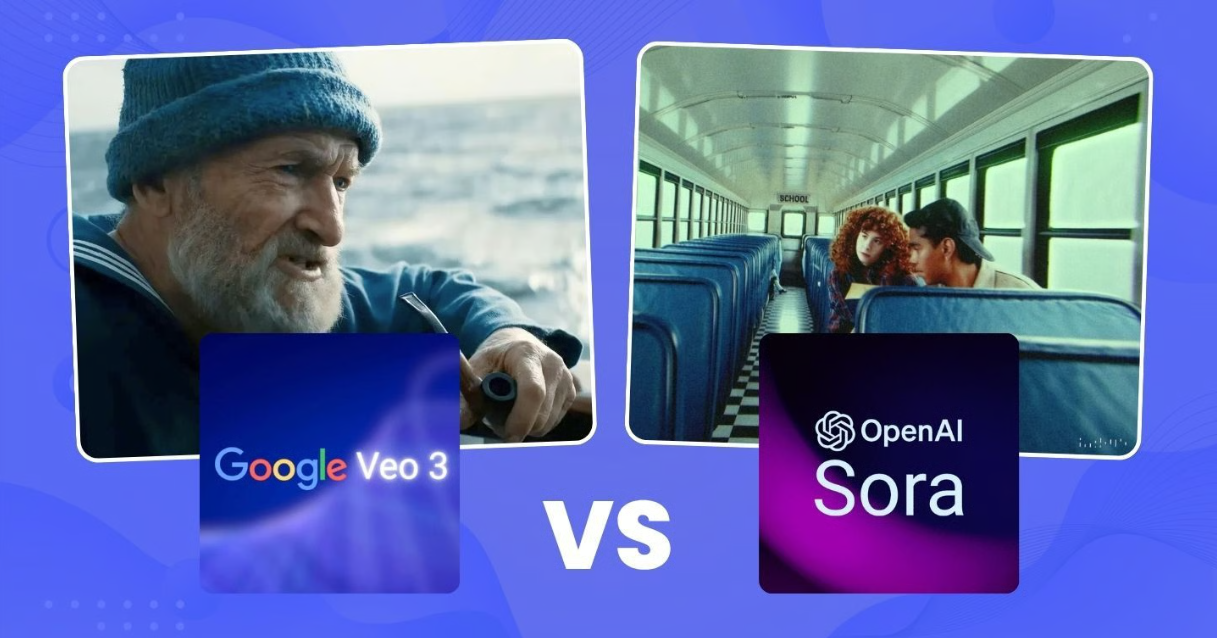
Overview of the video generation model of Google Veo 3 and OpenAI Sora
1. Google Veo 3
Introduced at the annual Google I/O conference, Veo 3 is Google DeepMind's most advanced video creation model today.
Technical highlights:
- Resolution: Create video up to 1080p, with 4K support in the future.
- Duration: Video is about 30 seconds, will be expanded in future updates.
- Input Type: Text and images.
- Scene control: High degree of control over camera movements, composition and angles.
- Style: Leaning toward realism and scientific accuracy.
- Ecosystem integration: Connect to YouTube, Google Cloud and Imagen.
- Audio sync: Having integrated sound (voice-over, background sound, music) is one of the highlights.
Veo 3 is said to use Transformer architecture combined with diffusion techniques, allowing for a clear understanding of spatial dynamics, physical laws and subtle movements.
Ideal application:
- Convenient for scientific visualization and clear communication of complex data.
- Great for pre-production planning and visual prototyping in filmmaking.
- Create beautiful advertising images and engaging, authentic social media content.
However, this outstanding performance also comes with limits. 249.99 USD/month (about 6 and a half million VND), Veo 3 is difficult to reach common users or small content creators.
2. OpenAI Sora
Launching in 2024, Sora is the next step in OpenAI's multimodal ambitions.
Technical highlights:
- Resolution: Up to 1080p.
- Duration: Can create videos longer than 60 seconds.
- Input Type: Enter text and images.
- Image style: Strong in artistic storytelling and cinema.
- Footage consistency: Maintain character shapes, movements, and backgrounds throughout scenes.
- Sound: Does not provide native audio generation and requires sourcing or creating your own audio.
- Ecosystem integration: Connect with ChatGPT, part of the Microsoft ecosystem, with plans to integrate multimedia in the future.
Featured applications:
- Best suited for cinematic storytelling and entertaining content.
- Create short films, branded content, and surreal or artistic video projects.
- Used to create immersive content for VR/AR environments and visual experiences.
Sora is strong at creating long-form videos and storytelling.
Compare Google Veo 3 and OpenAI Sora
First, about video quality, both platforms support video export at up to 1080p resolution, but Google Veo 3 plans to expand to 4K in the future, providing sharper images for those who need higher resolution.
About maximum video length, Google Veo 3 is currently limited to about 30 seconds, suitable for short, quick videos, like short commercials or compact educational videos.
Ability to control footage is also a clear difference between the two platforms.
About visual style, Google Veo 3 prioritizes realistic and scientific images, very suitable for educational content, research and videos that require high realism.
About use cases, Google Veo 3 is best suited for educational videos, research, and visual presentations that require high precision.
Final, about accessibility, Google Veo 3 is currently still in a limited access phase and is mainly for testing partners, while OpenAI Sora is already accessible through ChatGPT and is strictly controlled to ensure user safety and convenience.
In short, Google Veo 3 is strong in short, accurate and highly scientific videos, suitable for those who need accuracy in images and sound.
Strengths and limitations between the two software
Google Veo 3
Advantage
- Realism & accuracy: Best reproduction of real physics and environments.
- Audio integration: Create top-notch immersive experiences.
- Scientifically accurate: Great for simulation, training or data visualization.
- High scene control: Easily set up complex scenes.
Limit
- High cost: Limited to general users.
- Slow processing: Detailed output takes a lot of time.
- Not yet widely available: Access remains limited.
OpenAI Sora
Advantage
- Storytelling tools: Great for creators who want to create long-form, seamless content.
- Ease of use: Simple interface, suitable for even newbies.
- Editing features: Tools like Recut, Remix, Storyboard help make quick adjustments.
- Longer duration: Supports videos over 1 minute – good for storytelling.
Limit
- No sound yet: Limited to certain video genres.
- Lower image detail: May not be as realistic as Veo 3.
Ethical impact and change in the creative industries
The rise of AI video creation platforms like Google Veo 3 and OpenAI Sora not only opens a new era of creativity, but also poses a series of ethical issues and challenges for the content industry.
Conclusion: Who will lead the way in 2025?
The race between Google Veo 3 and OpenAI Sora is not a “winner or loser” game.
- If the goal is to recreate reality, accurately simulate engineering then Google Veo 3 is the choice thanks to its strong physical capabilities, integrated sound and sharp images.
- If you want to tell stories, make art, create social media content OpenAI Sora is the ideal platform with high flexibility, long duration and friendly interface.
The answer to “Who will dominate 2025?”
The above tools are the door that opens the future of digital content.
2025 may not determine the ultimate winner, but it will certainly mark the mass adoption of AI-generated video.
Dieu Anh (According to HitPaw VikPea)